

We collect human motion data for robot learning in four ways: first-person (egocentric) video from a head camera, a head camera plus two or three fixed cameras for measured 3D hands, synced drones for whole bodies on real outdoor ground, and handheld-gripper demonstrations. Every clip comes with a per-second QA report, and the multi-view captures add 3D labels with an error measured against a camera held out of the solve. Some data is ready now in the catalog, larger collections are released on request, and we capture new data to your spec.
01What we capture
Each rig records something different. Pick by the skill you are training and where the robot will work.
| Rig | What it records | Labels | Where |
|---|---|---|---|
| Egocentric (head camera) | What the wearer sees and does with their hands, with IMU or phone pose (ARKit or ARCore) where recorded | Per-second QA timeline, task titles and step lists | Homes, workplaces, public spaces |
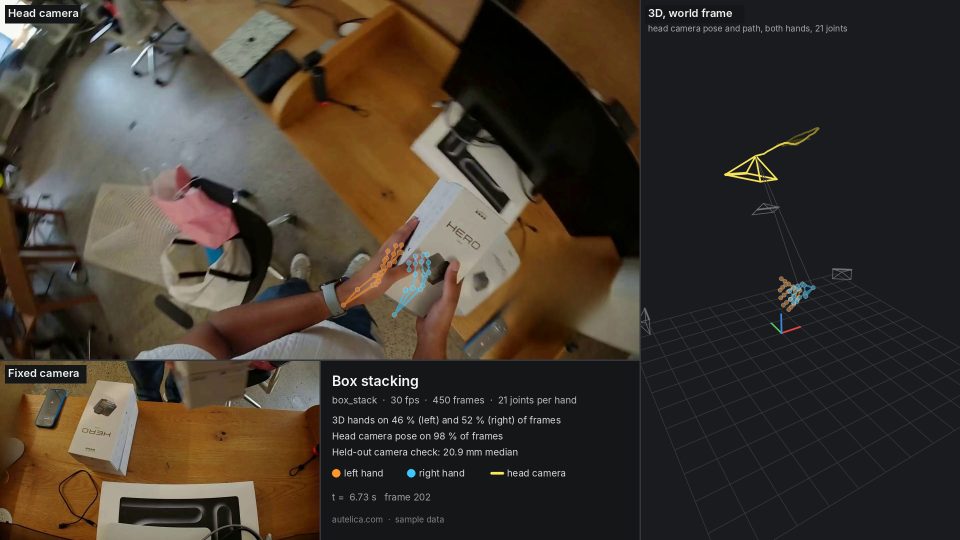
| Head camera + 2–3 fixed cameras | The same first-person view, plus outside views of the hands and objects, synced from the footage | 3D hands (21 joints each) in one world frame, head camera pose, objects, contacts | Workbenches, kitchens, work cells |
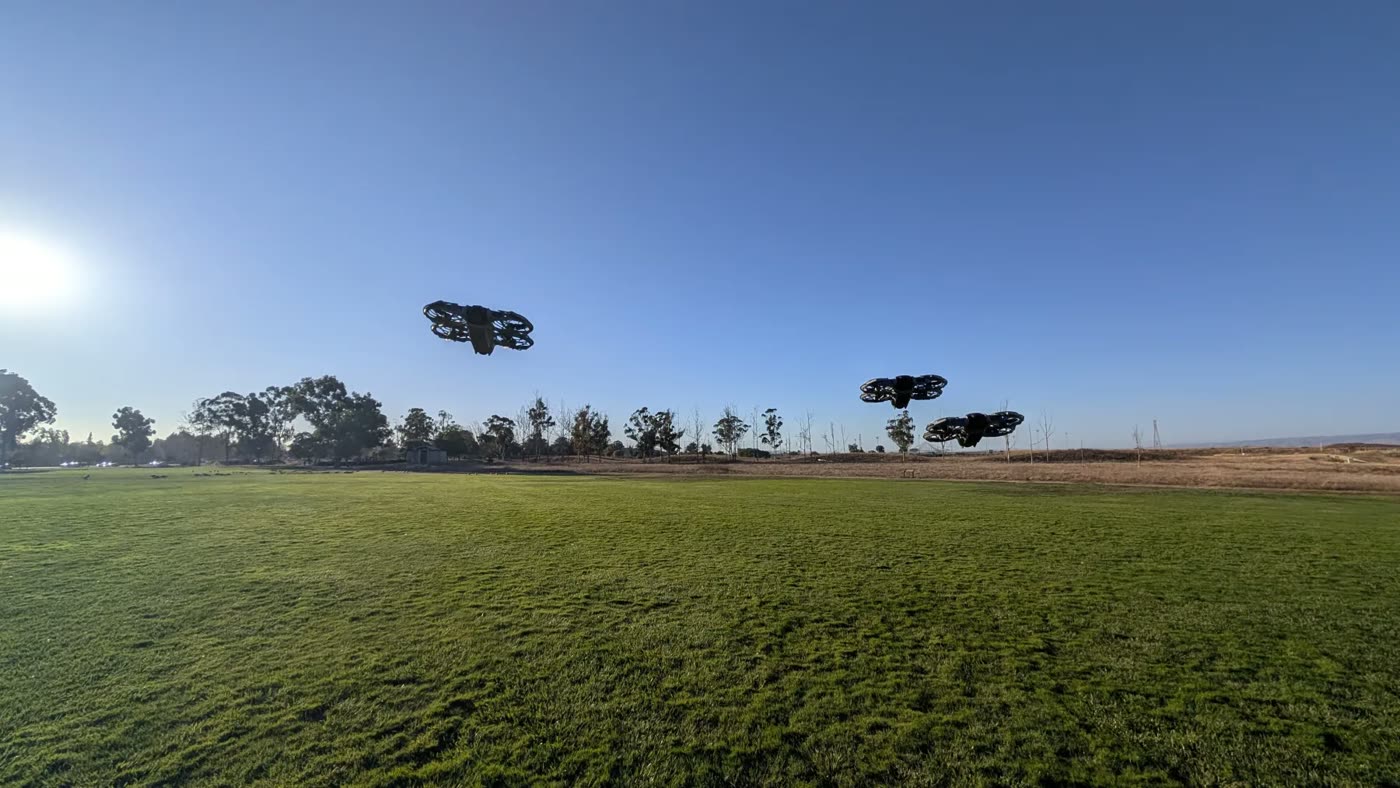
| Synced drones | Whole bodies moving over real ground, from three drones on one clock | 3D body, foot contacts, measured terrain, camera pose per frame | Outdoor sites you choose |
| Handheld gripper (UMI-style) | Gripper trajectory, opening and wrist-camera video | QA timeline and trajectory checks | Indoor manipulation |
The data catalog lists each source with its hours, settings, cameras, labels and availability, and shows which ones have a public sample.
02First-person video data for robots
Egocentric video has the volume. It is cheap to record at scale, it sees the hands up close, and it covers the homes and workplaces where robots are meant to work. It also has limits: a head camera sees little of the wearer’s body, hands leave the frame when the head turns, and one camera has to guess depth. For that reason we ask for phone pose data (ARKit or ARCore) and a step list with every egocentric order, and we add fixed cameras where you need measured 3D hands rather than estimates.
03How a collection runs
- Scope. We agree the tasks, settings, hours, cameras, labels, formats and acceptance criteria before anything is filmed.
- Consent. Participant and site releases are collected for every session. Capture does not start without them.
- Capture. Head cameras, fixed cameras or drones, depending on the rig. Outdoor drone work is flown by licensed pilots, one per drone.
- Check. Footage goes through the Check API: a per-second timeline of usable footage, a reason for every bad second and a verdict for the session.
- Measure. On multi-view captures, cameras are calibrated without markers and the 3D hands or bodies are solved, then checked against a camera left out of the solve.
- Deliver. Clips that miss the agreed gates are cut, and the rest ship in your formats with a checksum manifest.
04QA on every clip
Raw hours are not the same as usable hours. Every delivery carries a QA report that marks each second as usable or not and gives a reason for the rest: a blurry head camera, bad exposure, a fixed camera that moved, or hands out of view. The report is the same JSON the Check API returns (see an example report). On multi-view captures each clip also carries a held-out camera error. How we label and check data is covered in human motion data annotation and QA.
05Measured accuracy
| Check | Result |
|---|---|
| Tabletop hands, held-out camera | 12–15 mm median; hands found in 81–98% of frames |
| Hands vs marker motion capture (public benchmark) | About 3 cm, against 7–10 cm for head-camera methods on the frames every method covers |
| Outdoor body, held-out drone | 5–8 px median at 1080p |
| Terrain slopes vs survey lidar | Within 10 cm at p90, against about 70 cm when the ground is guessed from motion |
Each number says what it was checked against. The full table and the method are on how it works.
06Formats
Video as MP4 (H.264), arrays as NPZ, labels and QA reports as JSON, robot trajectories as CSV, terrain as OBJ, height field, MuJoCo MJCF or URDF. LeRobot, HDF5 and MCAP are converted from the same files on request. One metric world frame per capture, and frame i of every video is frame i of the data.
07What to know first
- Robot results on our data so far are in physics simulation and on public benchmarks, not on real robots.
- Egocentric-only data is labelled for quality, tasks and steps. Measured 3D hands need the fixed cameras.
- Rights on partner collections are confirmed per order; our own captures are under releases we collected.
Questions
How is human motion data for robots collected?
With cameras or sensors on and around people doing real tasks: head cameras for first-person video, fixed cameras or drones for outside views that can be triangulated into 3D, handheld grippers for manipulation demos, or mocap suits and studios. We use cameras only, so nothing is worn but a head camera.
Do the people filmed give consent?
Yes. Participant and site releases are collected for every session we capture. For collections released on request, rights are confirmed per order.
Can I see a sample before ordering?
Yes. Two samples are public on the samples page: a three-drone body capture under CC BY 4.0 and five tabletop 3D hands clips under an evaluation licence. Samples of the other sources are shared on request from the data catalog.
How is the data checked?
Every clip gets a per-second QA report with a reason for each unusable second and a verdict. Multi-view captures also carry an error measured against a camera left out of the 3D solve.
Which formats do you deliver?
MP4, JSON, NPZ and CSV, with terrain as OBJ, MJCF or URDF. LeRobot, HDF5 and MCAP on request.