
Three 4K cameras at 50 frames a second, 16 m from the athlete, spread over one side of the field. The feeds are their real pixels.
AutelicaHow it works
How we measure motion from ordinary cameras.
A real three-second catch, filmed by three synced cameras on tripods. Line up their clocks, find his joints in 3D, then put a camera where none stood and watch the picture get rebuilt from the real pixels.
Distance–
Covered–
Three views of one moment
Three cameras film the same three seconds.
Real footageChecked on this take: top speed 17.8 km/h against the dataset’s published 3D reference of 18.1; joints 45 mm from that reference’s on average.
Loading the capture…
What you’re looking at
Computed live from the footage
File timestamps only say which second a clip started. We find the exact offsets from the athlete: only the right ones make the three views agree on one body. On this take it lands within 4 ms; across 35 public clips the median error is 1.2 ms. These three cameras were wired together; the lab unsyncs them on purpose, which is what three drones look like.
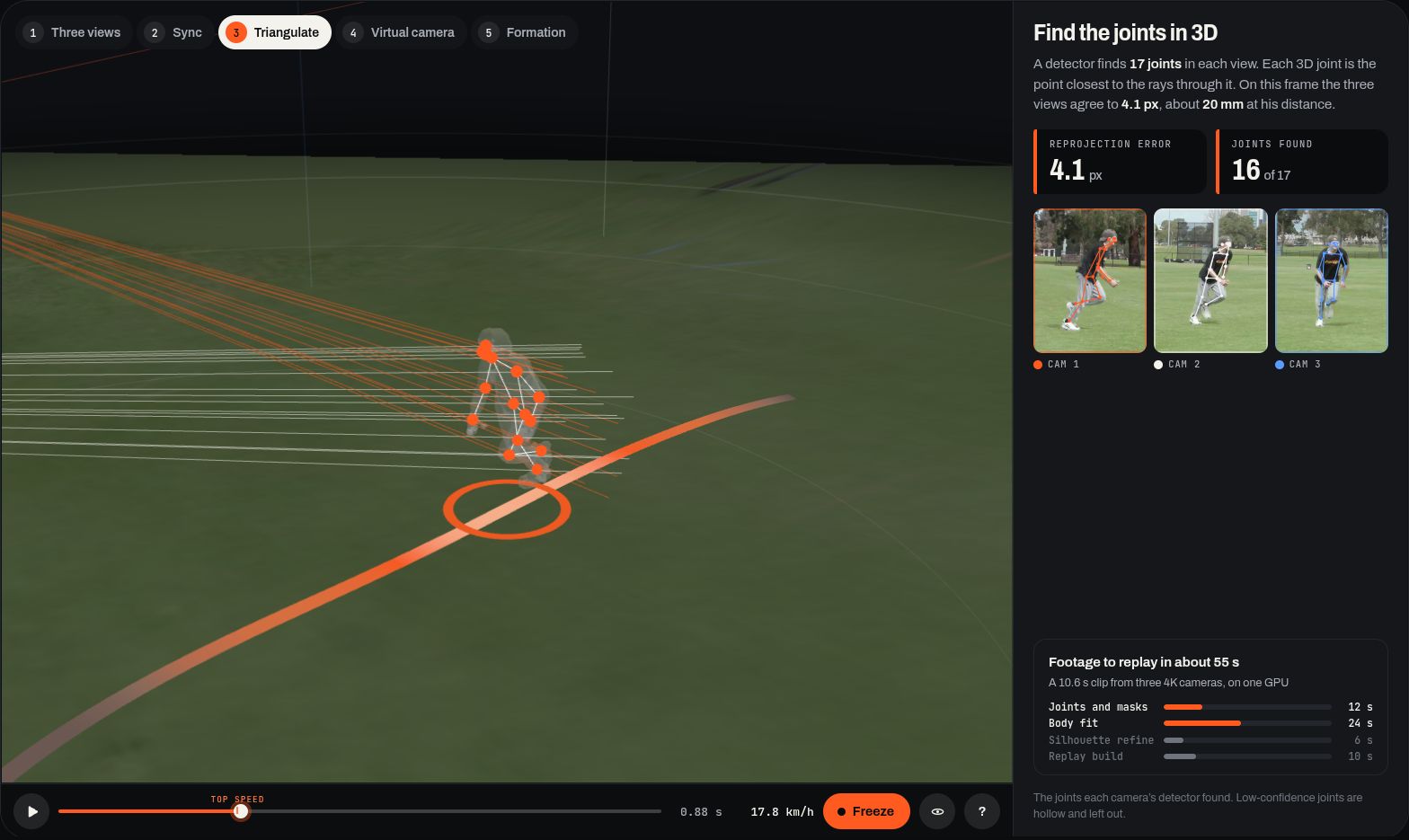
A detector finds 17 joints in each view. Each joint in 3D is the point closest to the three rays through them. The body model is then fitted to those joints and to the three silhouettes.
Each pixel of the athlete is painted from the real cameras, weighted by how close each one is to your viewpoint and whether it could see that spot. The athlete is never generated. Where no camera saw the background, it is filled in, and the lab marks those directions as guessed.
The picture is only as good as the nearest real camera. That is why we place cameras, or fly drones, about 120° apart around the person instead of three on one side. The ring measures the angle around him to the nearest camera, ignoring camera height.
Footage: a public research capture, free to reuse, filmed with three tripod cameras. The people in it are not Autelica customers.