AutelicaRobotics data

Markerless multi-view motion capture for robot learning.

Unsynchronised consumer cameras (2–5 exocentric views, 3 or more recommended, optionally one egocentric head camera) are synchronised and calibrated from the footage. Body, hands and head are triangulated in a metric world frame. Each clip includes a held-out-camera error report and a physics-tracking evaluation on a Unitree G1.

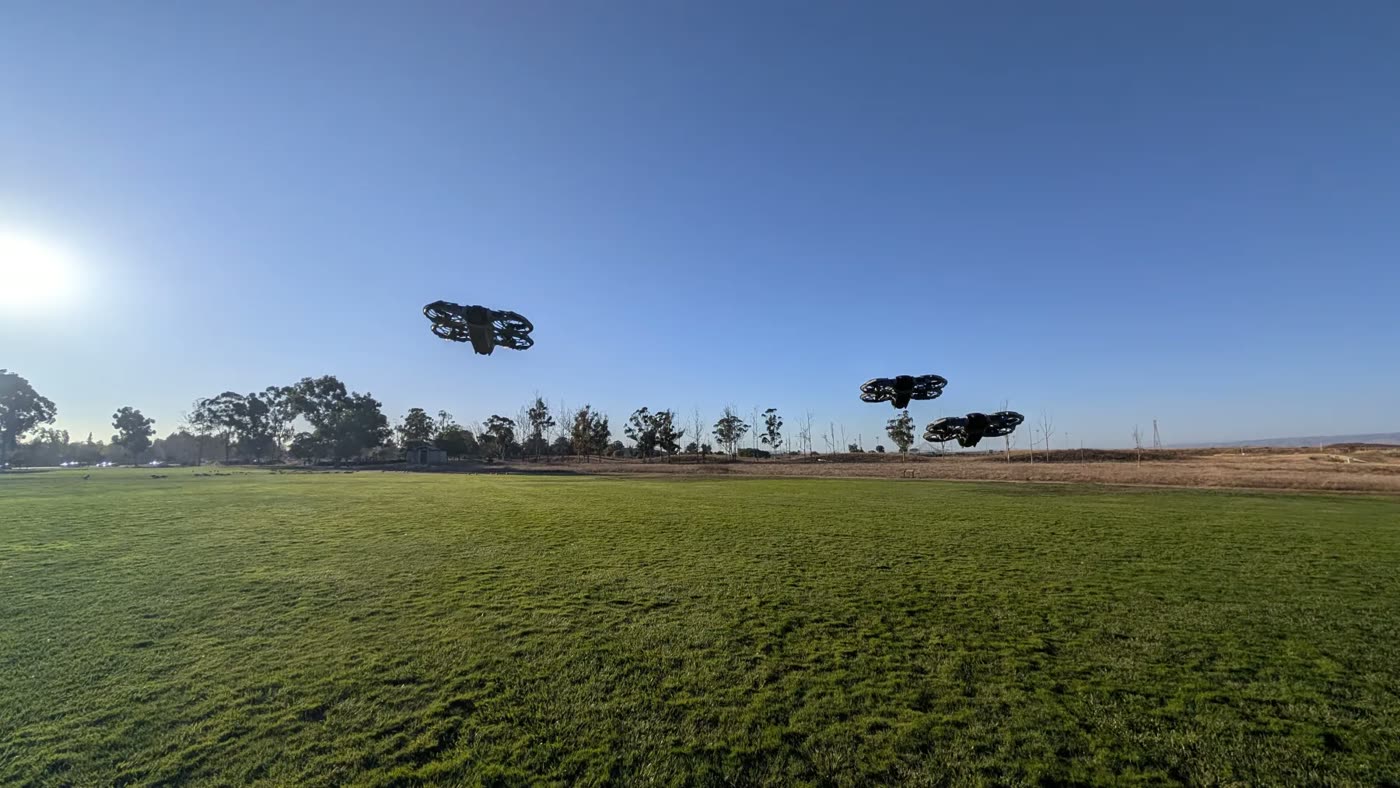
Three small drones hovering over a grass field against a blue skyOur flight, Sep 30
Sep 30, 2026 flight. Clock offsets of up to 1 s and camera poses recovered from the footage.

Motivation

Validating egocentric data

Egocentric datasets for robot learning are labelled at scale by monocular 3D hand, body and head-pose estimators. A head-mounted camera observes the wearer's hands but little of the body, and monocular estimates carry depth and scale ambiguity. Synchronised, calibrated exocentric views constrain the same frames geometrically, which yields metric labels and a per-clip measure of label error.

Applications

Use cases

Egocentric data collection

  • 3–5 tripod-mounted phones alongside the collector's head camera, synchronised in software
  • Metric 3D body, hand and head labels aligned to the egocentric stream
  • Reference sessions for measuring auto-label error across the wider collection
  • Pilot: one collection site; a capture day, then reference sessions as needed

Humanoid and robot learning

  • Evaluation sets for video-to-3D and video-to-robot methods, with per-clip error
  • Whole-body and high-speed motion, indoor or outdoor; drones as moving exocentric views
  • Retargeted G1 trajectories with physics-tracking results
  • Pilot: one site and one task, about four hours of filming; larger task sets scoped after

Data platforms

  • Calibration, synchronisation and 3D reconstruction as a processing layer
  • Per-clip accuracy metrics for downstream customers
  • LeRobot, HDF5, or MP4 with JSON annotations
  • Pilot: the 3D layer for one customer dataset

Data format

Clip contents

Delivered as LeRobot, HDF5, or MP4 with JSON annotations.

FieldContents
videoAll exocentric views and the egocentric stream at source resolution and frame rate.
timestampsPer-frame times on a common clock; per-camera offsets recovered in software (no genlock or timecode).
calibrationIntrinsics and extrinsics per camera in one metric world frame (z up, ground plane z = 0).
body_3dCOCO-17 joints, metres, per frame.
hands_3d21 keypoints per hand, metres, per frame; per-keypoint view count and reprojection error.
error_reportHeld-out-camera error: each camera is excluded from the solve in turn and the reprojection residual against its detections is reported in pixels and in millimetres at keypoint depth.
robotUnitree G1 joint trajectory (29 DoF) and physics-tracking metrics: fall, mean joint error, root drift.
consentPer-participant release and commercial licence; optional face blurring.

Library

Motion library

ItemStatus
currentOutdoor three-drone capture: locomotion, turns, running (Sep 30, 2026). Public sample: 8 s jog with a 90° turn
in collectionWorkplace tasks with multiple consented subjects: lifting, carrying, shelving, cart pushing, table work, tool use, stairs
sourcesOpt-in capture sessions only, written consent per participant; pilot data stays with the customer
indexClip list with tasks, subjects, duration and quality grade on request

Terms

Licensing and embodiments

Licence

  • Pilot data: perpetual, worldwide licence for commercial training and derived models
  • Library data: commercial licence by agreement
  • No redistribution of raw video; derived models are yours
  • Consent withdrawal removes the person from future deliveries
  • Public sample: CC BY 4.0

Embodiments and formats

  • Unitree G1 (29 DoF) validated today
  • Your humanoid: bring the URDF or MJCF; retargeting and physics checks scoped per pilot
  • Human outputs: COCO-17 body, 21-point hands, parametric body joints
  • Formats: LeRobot, HDF5, MP4 + JSON/NPZ

Benchmarks

Accuracy

Harmony4D is used for evaluation only. Its footage is not redistributed or used for training.

MetricResultProtocol
Software synchronisation1.2 msMedian offset error, p90 2.4 ms. Three cameras, 35 outdoor clips ≥ 4 s, ASPset-510.
Body MPJPE51.6 mmThree cameras, outdoor sports, ASPset-510.
Hand keypoint error17–19 mmMedian held-out-camera error, 3–5 cameras at ~2 m, indoor, Harmony4D.
Hand coverage under occlusion44% → 88%Hands triangulated with 3 vs 5 cameras; two-person close contact, Harmony4D.
G1 on our drone footage60 / 60Runs per segment in MuJoCo, 59 with random pushes, friction, mass, motor gains and 0–20 ms delays; three segments from the Sep 30 2026 three-drone flight; joint error 4.2–5.9°.
G1, three cameras vs dome12.9 vs 12.3 cmKeypoint error of policies trained on three cameras vs a 27-camera dome reconstruction, tennis clip, 59/59 runs each; single camera adds 3–6 cm. CMU Panoptic, evaluation only.
G1, 15-clip study551 / 590Randomized runs completed by policies trained on three-camera captures across 10 clips (dome-trained: 474 / 590). 5 further sport and dance clips are being re-scored: their dome reference was 0.7 s out of sync with the video. Once aligned, the three-camera capture agrees with it to 5.8–8.0 cm. CMU Panoptic, evaluation only.

Physics evaluation

Physics validation

Each clip is retargeted to the Unitree G1 with GMR (whole-body IK), checked for start-up transients, unobserved joints and foot contact, then tracked by a motion-tracking policy trained in MuJoCo (mjlab). Evaluation runs 60 times in plain MuJoCo with G1 torque limits: one nominal run and 59 with random pushes, floor friction, link masses, motor gains and control delays. Reported per clip: runs that stay up, keypoint error, bone-direction error and pelvis drift.

CaptureRuns upKeypoint error
Three drones, own flight, 3 segments60 / 60 eachjoint 4.2–5.9°
Three tripod cameras, sprint (ASPset-510)58 / 590.18 m path, median
Three cameras, tennis (Panoptic, eval only)59 / 5912.9 cm (dome 12.3)

Simulation only; real-robot runs are next. Write-ups: camera count and robot training, retargeting to a G1.

Drone footage + simulation
Drone footage (left). Unitree G1 tracking the captured motion in MuJoCo (right).

Pipeline

Pipeline

01 · Capture

Consumer cameras

3–5 exocentric phones at 1.5–2.5 m indoors, 4K, shutter ≤ 1/250 s, locked exposure and focus; one head-mounted camera. Drones for outdoor and moving capture.

02 · Synchronise

Audio, then geometry

Coarse offsets by GCC-PHAT on the audio tracks; refined by maximising epipolar-consistent joint correspondences across views, then jointly to sub-frame precision.

03 · Calibrate

Subject-based calibration

Relative poses initialised by essential-matrix RANSAC on the subject's 2D keypoints, then bundle adjustment of all cameras and points; focal length from lens metadata or estimated; metric scale from body proportions or the subject's height.

04 · Reconstruct

Body and hands

Body joints triangulated per frame. Hand crops placed by the 3D wrist; MediaPipe Hand Landmarker per view; per-keypoint RANSAC DLT with a reprojection gate.

Capture envelope

Capture envelope

ParameterRange
exo cameras2–5 per session (≥ 3 recommended; 5 for heavy hand occlusion)
frame rate20–60 fps
resolution1080p–4K
subject distance~2 m indoors (hands); up to ~20 m outdoors (body)
camera typesPhones, action cameras, consumer drones
scenesWorkplace and household tasks, sports, outdoor locomotion; one tracked subject per capture
throughputAbout 7× clip length on one GPU (a 6 s three-camera 4K clip in 40–45 s); batch processing scales across GPUs
processingHosted, or on-premises for sensitive sites

Your details are used only to reply to this request.

Related

References