

Humanoid teams usually record human motion in an optical mocap studio or with an inertial suit. Markerless multi-camera capture uses two to five ordinary synced cameras instead: drones outdoors, fixed cameras and a head camera indoors. The body and hands are triangulated in metres, the ground is measured from the same footage, and every clip is checked against a camera left out of the solve. In our simulation test, a Unitree G1 trained on three-camera capture tracked at 12.9 cm keypoint error, against 12.3 cm for the same motion from a 27-camera dome; one camera added 3–6 cm.
01The options compared
| Method | On the person | Where it works | Ground and scene |
|---|---|---|---|
| Optical mocap studio | Reflective markers | A studio with a fixed camera rig | A flat studio floor |
| Inertial suit | A suit of motion sensors | Anywhere | Not measured |
| Single-camera video | Nothing | Any video | Guessed; depth and scale ambiguous |
| Markerless multi-camera | Nothing, or a head camera | The real site, indoors or outdoors | Measured from the same footage |
Studios remain the most precise option for the body itself. The case for multi-camera capture is location: motion recorded on the slopes, steps, benches and workbenches the robot will meet, with the ground under the feet measured rather than assumed, and an error figure on each clip.
02How it works
- Sync without timecode. Camera clocks are lined up from the motion in the footage, so off-the-shelf cameras and drones work as they are.
- Calibrate without markers. Camera poses are solved from the scene, including moving drones on every frame.
- Triangulate. Every joint is seen from several sides, so depth comes from geometry rather than a guess. Hands are measured as 21 joints each.
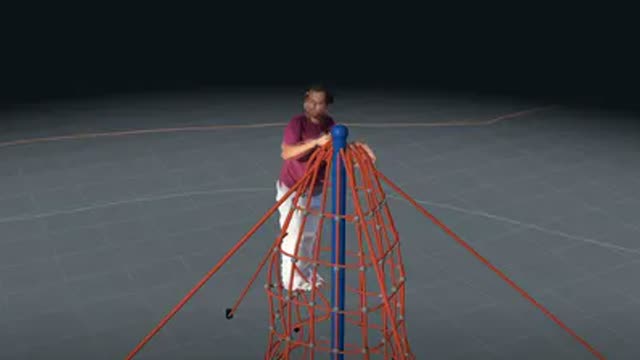
- Measure the ground. Terrain comes from the same footage: slopes within 10 cm of survey lidar at p90, against about 70 cm when the ground is guessed from the body’s motion.
- Check. Each camera is left out in turn and the 3D is compared with what it saw: 5–8 px median for outdoor bodies at 1080p, 12–15 mm for tabletop hands.
03From capture to a humanoid
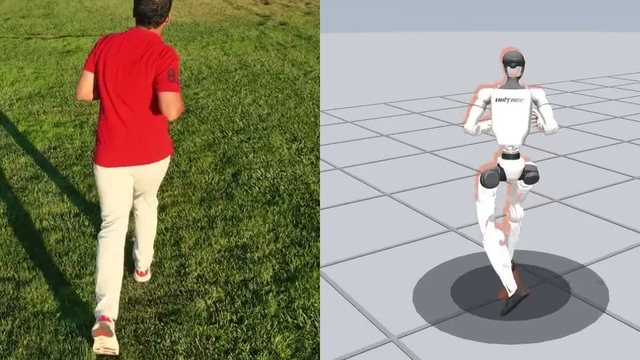
The measured motion is retargeted to the robot and placed on the measured ground. Retargeted Unitree G1 feet sit −0.1 cm from the surface at stance (median), and every retarget is tracked by a G1 in physics simulation before delivery. On our public sample, a three-drone jog with a 90° turn, the G1 finished 100% of its randomised runs without a fall. We deliver G1 and H1-2 joint trajectories as CSV and NPZ, with replay scripts for MuJoCo, Isaac Lab and Newton. The pitfalls are covered in retargeting human motion to a Unitree G1.
04How many cameras
We trained a G1 tracking policy on the same motion captured three ways. Three cameras matched a 27-camera mocap dome closely (12.9 vs 12.3 cm keypoint error), and a single camera added 3–6 cm (the full comparison; evaluation-only data, simulation). Outdoors we use three drones; indoors, two to four fixed cameras around the work area plus a head camera.
05What it does not do
- It is not real-time. Capture is processed after the session, so it is a source of training data, not a teleoperation rig.
- It needs each joint in view of at least two cameras. Stretches seen by fewer are left empty and flagged.
- Robot results so far are in physics simulation and on public benchmarks. We have not run a real humanoid on this data yet.
To see the data itself, open the interactive sample (camera poses, 3D joints, foot contacts, held-out error and the G1 trajectory, all downloadable), or scrub a captured walk over measured ground in the terrain lab.
Questions
Can you do motion capture for a humanoid robot without markers?
Yes. With two to five synced cameras the body and hands are triangulated in 3D, with no markers or suits. Each clip is checked against a camera left out of the solve, so its error is known.
Is markerless capture as accurate as a mocap studio?
Not for the body alone; a studio is more precise. In our simulation test the difference mattered little for a humanoid: 12.9 cm keypoint error from three cameras vs 12.3 cm from a 27-camera dome.
What do you deliver for a humanoid?
3D body joints in metres, foot contacts, the measured ground as a mesh or height field, and G1 or H1-2 joint trajectories checked in physics simulation, as CSV and NPZ with MuJoCo-ready scenes.
Does it work outdoors?
Yes. Outdoors we film with three small drones on one clock, flown by licensed pilots, and measure the ground from the same footage.