
On HO-Cap, a public hand-object dataset, we scored 3D hands on each of 8 people (64 sequences) with models trained only on the other seven. Errors are absolute 3D positions with no alignment to the reference. Off-the-shelf MediaPipe keypoints, tracked and smoothed, gave a median joint error of 9.9 mm with 8 cameras. A learned 3D correction to joint centres brought that to 6.2 mm, and our own 2D keypoint refiner to 5.4 mm. With 4 cameras the same steps gave 10.8, 7.2 and 5.6 mm. Per person the full pipeline ranged from 4.3 to 6.5 mm with 8 cameras and 4.2 to 8.0 mm with 4. Fingertips: 7.0 mm with either camera count. Most of the gain comes from correcting for detectors marking the skin while robot hand models use joint centres.
01What we measured
HO-Cap records people picking up and using everyday objects in a lab, filmed by 8 fixed colour cameras at 640×480 and 30 fps, plus a head-mounted camera. It ships 3D hand joints for every frame and is released under CC BY 4.0 by Wang et al. at UT Dallas and NVIDIA. We grouped its 64 sequences by person, which gives 8 people, and ran leave-one-person-out: for each person, every learned part of our pipeline was trained on the other seven and then scored on that person alone. The reference labels are used only for training and scoring; at run time the pipeline sees only the camera images and calibration.
The score is the distance between our 3D joints and HO-Cap’s, over all 21 joints of each hand. Errors are absolute positions in the camera rig’s world frame, with no alignment to the reference, so wrist position counts too. Many published hand-pose numbers are reported after aligning each hand to the ground truth, which removes that part of the error, so compare with care. We report the median per person, then the median over people. We ran everything twice: with all 8 cameras, and with 4 of them. The 4 were picked per sequence as the cameras where the detector found hands most often, without looking at the reference labels.
02Results
Median 3D hand-joint error on people left out of training
8 cameras
4 cameras
Each step helps at both camera counts. The refiner closes most of the gap between them: 1.0 mm before it, 0.2 mm after. With it, 4 cameras (5.6 mm) beat 8 cameras without it (6.2 mm). Fingertips, which matter most for grasping, go from 11.6 mm to 7.0 mm with 8 cameras, and reach 7.0 mm with 4. The full pipeline’s per-person results:
| Person | Sequences | 8 cams, off-the-shelf | 8 cams, ours | 8 cams, ours p90 | 4 cams, ours | 2D error before → after |
|---|---|---|---|---|---|---|
| A | 7 | 11.1 mm | 5.9 mm | 12.0 mm | 6.8 mm | 6.7 → 3.9 px |
| B | 18 | 10.3 mm | 5.3 mm | 10.8 mm | 5.7 mm | 6.3 → 3.9 px |
| C | 11 | 9.1 mm | 4.4 mm | 9.6 mm | 4.2 mm | 5.0 → 2.8 px |
| D | 3 | 9.6 mm | 5.5 mm | 12.4 mm | 5.4 mm | 6.6 → 3.5 px |
| E | 7 | 8.7 mm | 4.8 mm | 10.5 mm | 4.9 mm | 6.0 → 3.7 px |
| F | 7 | 11.2 mm | 6.5 mm | 13.3 mm | 8.0 mm | 6.9 → 4.9 px |
| G | 4 | 11.2 mm | 5.8 mm | 13.0 mm | 6.5 mm | 7.0 → 3.9 px |
| H | 7 | 9.5 mm | 4.3 mm | 8.7 mm | 4.6 mm | 5.9 → 3.1 px |
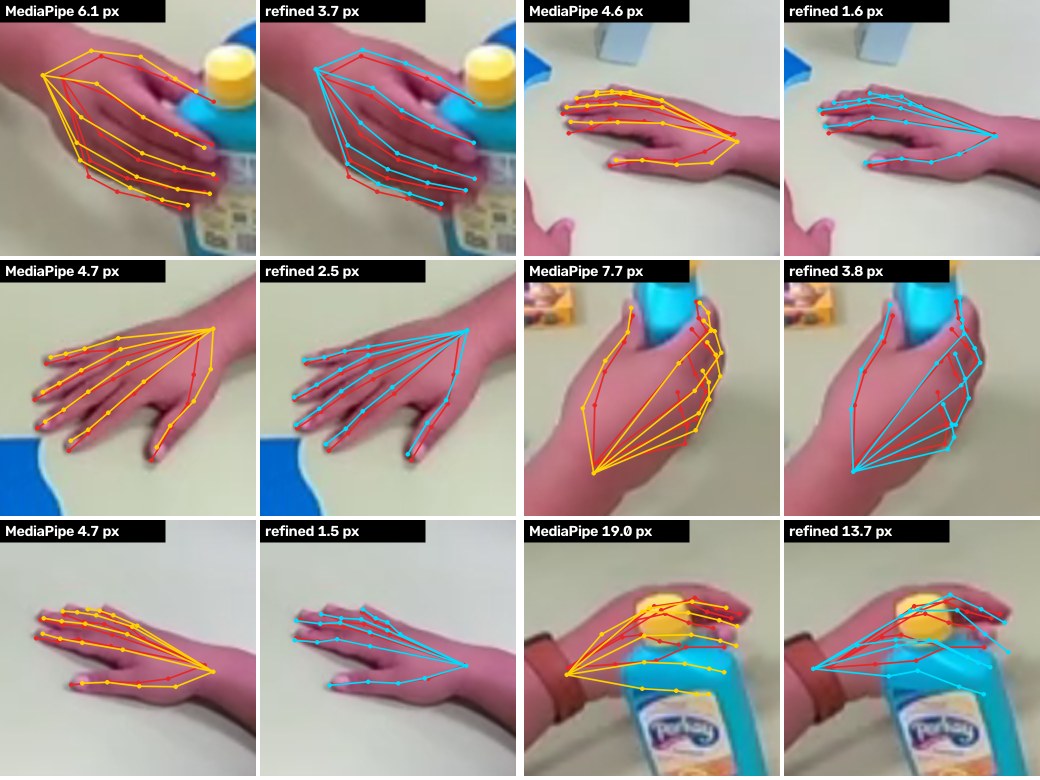
The p90 column is the error that 90% of joints stay under. The 2D column is keypoint error inside 128-pixel hand crops, before and after our refiner; it falls by about 40% at the median, and by 29–47% per person. Person F is the weakest, at 6.5 mm with 8 cameras and 8.0 mm with 4.
03Skin keypoints and joint centres
Off-the-shelf hand detectors such as MediaPipe are trained on images labelled by people, who click on the visible surface of the hand. A robot hand model, a physics simulator and a dataset like HO-Cap all describe the hand by its joint centres, which sit inside the finger. At the knuckles the two differ by 15–21 mm on HO-Cap. Triangulating skin points perfectly still leaves that offset, which is why our first versions stalled at about 11 mm no matter how many cameras we added.
The first fix works in 3D. We express the 21 triangulated points in the hand’s own frame and fit a small learned correction that moves each one toward its joint centre, depending on the pose. Trained on one person it carried over less well to others; trained on seven it brought held-out people from 9.9 to 6.2 mm with 8 cameras.
04Why several cameras
From one camera, how far away a finger is has to be guessed. With two or more calibrated cameras each joint is triangulated, so depth comes from geometry. More views also mean that when an object hides a finger from one camera, another usually sees it. We triangulate each joint separately and reject views that disagree with the rest, so one bad detection does not drag the whole hand.
05Tracking, crops and smoothing
Detectors miss small or partly hidden hands in a full frame. Once a hand has been triangulated, we project it into every camera and re-run the detector on a crop around where the hand should be. This raised the share of frames with a usable detection and lowered error by about 1 mm. Hands are linked over time into tracks, which tell left from right without any ground truth, and a smoothing pass removes most of the frame-to-frame jitter.
06Our 2D keypoint refiner
The 3D correction can only adjust what the cameras reported. The refiner fixes the 2D keypoints before triangulation. For each hand crop it takes the 21 points from the off-the-shelf detector, samples image features at those points from a frozen DINOv2-small backbone (Apache-2.0), and passes them with the point layout through a small two-layer transformer. The output is a shift per point, from where the detector put it toward the joint centre. With person B held out, it trained on about 51,000 crops of the other people.
07Checking head-camera hand labels
Hands leave the head camera’s frame, overlap and blur when the head turns, so automatic hand labels in first-person video drift. Once the outside cameras have a 3D hand, we project it into the head camera and flag the frames where the head-camera keypoints disagree with it. We are measuring how well those flags match the ground truth with the current pipeline and will publish precision and recall here.
08Labels without annotators
The refiner learned from HO-Cap’s labels, which are themselves built from many views. Our own captures can work the same way: where several cameras agree on a 3D hand, projecting it back into each view gives 2D labels for every camera, including the head camera, with no one clicking points. Training the refiner on those labels should let later captures in similar settings get by with fewer cameras. We have not yet measured this beyond HO-Cap.
09Limits
- HO-Cap’s cameras are 640×480 lab cameras at fixed positions. Phones and head cameras in a real workplace will behave differently.
- The reference labels are not exact. They are fitted from the dataset’s own camera rig rather than markers, so part of the remaining 5 mm may be theirs.
- Fingers hidden behind an object are the main failure. The refiner helps less there, as the bottle grasp above shows.
- Eight people is a small group. Results varied from 4.3 to 6.5 mm across them with 8 cameras.
- The 3D correction for each held-out person was fitted on the other people’s refined keypoints, which came from a refiner that had trained on those same people. The held-out person was never seen, but those training inputs were slightly cleaner than they would be on new data.
- Our own captures, a head camera plus phones, are the next test.
10What a capture delivers
- Per frame and per hand: 21 joint centres in millimetres in one world frame, left/right labels; 3D body alongside.
- Per clip: synced video from every camera, camera poses, and an error figure from cameras held out of the reconstruction.
- For first-person data: the frames where head-camera hand labels drift from the outside-camera 3D.
- On request: the motion retargeted to a robot body or robot hand.
Marker-based optical mocap is more precise but needs markers on the hand, which get hidden in grasps; this needs only ordinary cameras around the work area.
Questions
How accurate is markerless multi-camera 3D hand capture?
On the HO-Cap dataset, scored on people left out of training, our pipeline reached a median joint error of 5.4 mm with 8 cameras and 5.6 mm with 4, against 9.9 and 10.8 mm for off-the-shelf keypoints that were tracked and smoothed.
How accurate are MediaPipe hand keypoints in 3D?
Triangulated from 8 cameras and tracked, MediaPipe hand keypoints were 9.9 mm from HO-Cap’s joint centres at the median. Most of that is not noise: detectors mark the visible skin, while robot hand models and 3D datasets use joint centres inside the finger, 15–21 mm apart at the knuckles. Correcting for that brought the error to 5.4 mm.
What does a multi-camera hand capture deliver?
21 joint centres per hand per frame in millimetres in one world frame, left/right labels, the 3D body, synced video and camera poses, an error figure per clip, and on request the motion retargeted to a robot hand or body.
How many cameras do you need for 3D hands?
With our keypoint refiner, 4 cameras gave 5.6 mm on HO-Cap, better than 8 cameras without it (6.2 mm). Fingers hidden behind objects are still the main source of error.